
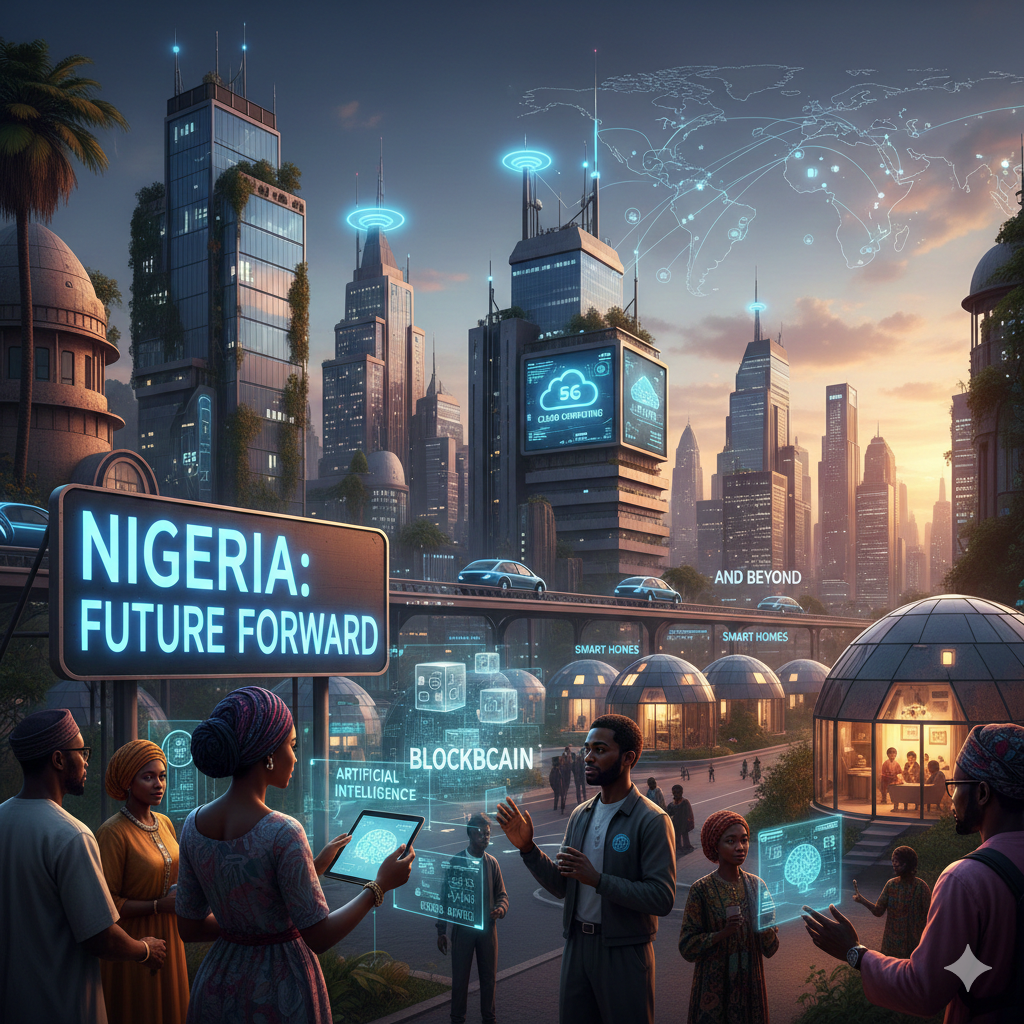
Adoption and Impact of 5G, Cloud Computing, Smart Homes, Artificial Intelligence, and Blockchain in Nigeria and Beyond
Abstract
Emerging technologies such as 5G, cloud computing, smart homes, artificial intelligence (AI), and blockchain are reshaping economies and societies across the world. These technologies form the digital backbone of Industry 4.0—characterized by ubiquitous connectivity, automation, and data-driven intelligence. Drawing on recent international and Nigerian sources, this paper examines the adoption, diffusion, and socio-economic impacts of these technologies in Nigeria and globally.
Findings reveal that while global uptake is rapid, Nigeria’s adoption remains constrained. By late 2024, 5G penetration in Nigeria stood at 2.46 percent of mobile subscriptions (NCC, 2025). Cloud computing adoption reached only 27 percent of organizations, though forecasts suggest it could contribute ₦30.2 trillion to GDP by 2033 (Balogun, 2023). Nigeria’s smart-home market was valued at US $247 million in 2024, growing toward US $388 million by 2028 (Urban Living NG, 2024). AI usage is rising—70 percent of online Nigerians report experimenting with generative AI (Vanguard Nigeria, 2025). Blockchain remains nascent but has clear potential to enhance transparency, trust, and digital finance (World Bank, 2024).
Using the Diffusion of Innovations, Technology Acceptance Model (TAM), and Unified Theory of Acceptance and Use of Technology (UTAUT), the paper analyzes the patterns, barriers, and enablers of adoption. It concludes that Nigeria’s success with these technologies depends on improved infrastructure, human-capital development, and policy alignment. Recommendations are made for government, industry, and academia to accelerate adoption through digital-skills investment, data-center expansion, and regulatory clarity.
Introduction
The world is entering an era of deep digital transformation driven by emerging technologies that are changing how people live, work, and interact. Among the most transformative of these are 5G, cloud computing, smart home systems, artificial intelligence (AI), and blockchain. Together, they represent the foundation of the global digital economy, improving connectivity, data access, automation, and security.
5G is not just a faster mobile network; it represents a major shift in communication technology by providing extremely high-speed, low-latency connections that enable realtime digital services. Cloud computing allows organizations and individuals to store, process, and access data from anywhere, eliminating the need for costly on-site infrastructure. Smart home technologies, part of the larger Internet of Things (IoT) ecosystem, enhance convenience, energy management, and security through connected devices. Artificial intelligence drives automation and intelligent decision-making across sectors such as healthcare, education, and finance. Finally, blockchain provides a decentralized and transparent approach to recording transactions, reducing fraud and enhancing trust in digital interactions.
In Nigeria, the adoption of these technologies reflects both opportunity and challenge. The country has one of the fastest-growing digital populations in Africa, with over 164 million internet users and more than 219 million active mobile subscriptions as of late 2024 (Nigerian Communications Commission [NCC], 2025). However, broadband quality, affordability, and power supply remain persistent obstacles to achieving largescale digital inclusion. Despite these challenges, the government has shown commitment through policies such as the National Broadband Plan (2020–2025) and the National Artificial Intelligence Strategy (2020–2030).
The expansion of these technologies carries strong socio-economic implications. For instance, 5G has the potential to accelerate Nigeria’s smart city and e-governance initiatives. Cloud computing can drive economic diversification by supporting fintech, ecommerce, and education platforms. AI could improve agriculture, healthcare delivery, and manufacturing productivity. Blockchain technology could help tackle corruption by making government transactions traceable and tamper-proof. Smart home innovations, though still in early stages, are beginning to redefine energy consumption and household safety for urban populations.
However, Nigeria’s digital transformation journey faces multiple barriers. These include inadequate infrastructure, high operational costs for telecom companies, limited digital literacy, and regulatory uncertainty—especially in blockchain and data privacy. Compared to global averages, adoption rates in Nigeria are still relatively low, reflecting the need for a stronger enabling environment.
This paper aims to provide a balanced assessment of how these five technologies are evolving, how they are being adopted both globally and locally, and what factors influence their acceptance and diffusion in Nigeria. It will explore existing gaps in technology implementation and propose recommendations to enhance the nation’s readiness for the digital future. The discussion builds on established theoretical models of technology diffusion and acceptance while emphasizing practical strategies that could help Nigeria move closer to global digital standards.
Related Literature
This section reviews prior research and recent reports on the five technologies 5G, cloud computing, smart homes, artificial intelligence (AI), and blockchain with a focus on how they have evolved globally and in Nigeria.
5G Technology
Globally, 5G networks have been recognized as a transformative leap in mobile communication. Studies by the GSM Association (GSMA, 2025) indicate that by 2030, about 54 percent of global mobile connections will operate on 5G. The technology enables new applications such as autonomous vehicles, smart factories, and real-time remote surgery. Countries such as China, South Korea, and the United States have achieved large-scale rollout through aggressive infrastructure investments.
In Nigeria, adoption has been gradual since the first 5G services were launched in 2022.
According to the Nigerian Communications Commission (NCC, 2025), by December
2024 there were about 4.05 million 5G subscriptions, representing 2.46 percent of total mobile subscriptions. Eleanya (2025) attributes this slow growth to high equipment costs, limited consumer awareness, and the expense of expanding network coverage. Similarly, GSMA (2025) points to the need for low-frequency spectrum allocation and better electricity supply to make 5G deployment sustainable across Africa.
Cloud Computing
Cloud computing has revolutionized how organizations manage IT infrastructure by offering flexibility, cost efficiency, and scalability. Globally, it has become the backbone of digital transformation, with adoption rates exceeding 90 percent among large enterprises (Balogun, 2023). The World Economic Forum (2024) describes cloud computing as essential for data analytics, remote work, and artificial intelligence applications.
In Nigeria, adoption is still developing. A study commissioned by Amazon Web Services (AWS) found that by 2021, only 27 percent of Nigerian organizations were using cloud services, compared to about 49 percent in Europe and North America (Balogun, 2023). However, the same study projects that if adoption reaches 50 percent, it could contribute up to ₦30.2 trillion to Nigeria’s GDP by 2033. Barriers identified include unreliable
internet access, data privacy concerns, and insufficient skilled professionals. The National Information Technology Development Agency (NITDA, 2019) introduced a Cloud Computing Policy requiring that all government data be hosted locally to promote data sovereignty.
Smart Homes
Smart home systems, which include interconnected devices such as thermostats, lighting controls, and security cameras, are expanding globally through advances in the Internet of Things (IoT). According to Statista (2025), there were over 18 billion connected IoT devices worldwide by the end of 2024. These technologies enhance convenience, energy efficiency, and security for users.
In Nigeria, adoption is still at an early stage but growing. The Urban Living NG Report
(2024) estimated that the Nigerian smart home market was valued at US $247 million in
2024 and projected to reach US $388 million by 2028. The report also noted that about
32 percent of Nigerian households are expected to use at least one smart device by 2025. However, Gbonegun (2022) observed that these devices are concentrated in highincome urban households due to high costs, limited local manufacturing, and unstable electricity. Studies by Okafor and Akinyemi (2023) also highlighted security concerns and lack of consumer awareness as barriers to widespread adoption.
Artificial Intelligence (AI)
Artificial intelligence has become a core driver of global technological advancement. PwC (2024) estimates that AI could contribute US $15.7 trillion to the world economy by 2030. In developed countries, AI systems are being integrated into logistics, healthcare diagnostics, and financial analytics.
Nigeria has begun to recognize the potential of AI for economic diversification.
According to the National Artificial Intelligence Strategy (Federal Ministry of Communications, 2020), AI can drive productivity in agriculture, education, and healthcare. Recent surveys suggest that 70 percent of online Nigerians have experimented with generative AI tools such as ChatGPT and Gemini (Vanguard Nigeria, 2025), one of the highest adoption rates globally. However, Ogunbodede and Atchrim (2025) argue that the lack of structured data, limited computing power, and few local AI researchers restrict large-scale implementation. The National Centre for Artificial Intelligence and Robotics (NCAIR) has been established to address these challenges and promote domestic innovation.
Blockchain Technology
Blockchain is a decentralized ledger system that provides transparency, immutability, and security for digital transactions. Globally, blockchain is transforming finance, healthcare, and logistics. The World Bank (2024) reports that blockchain adoption in Africa can improve land registry systems, combat corruption, and facilitate cross-border trade. In Nigeria, blockchain has gained visibility through cryptocurrency trading, fintech applications, and identity verification.
However, regulatory uncertainty has slowed its formal integration into mainstream financial systems. The Central Bank of Nigeria (CBN, 2021) initially restricted cryptocurrency transactions, citing concerns about fraud and money laundering. Despite this, the eNaira, Nigeria’s central bank digital currency, was launched in 2021 as an official blockchain-based initiative. Analysts such as Okechukwu and Adigun (2024) suggest that with clear regulation, blockchain could enhance supply-chain transparency and government accountability.
Summary
In summary, existing literature shows that while Nigeria is adopting these technologies at varying speeds, progress remains uneven. 5G and AI show promising growth, while cloud computing and blockchain are advancing through policy support. Smart homes are expanding slowly due to affordability issues. The reviewed studies consistently highlight infrastructure, cost, and digital literacy as cross-cutting barriers to widespread adoption.
Evolution, Diffusion, and Uptake of 5G, Cloud Computing, Smart Homes, Artificial Intelligence, and Blockchain
This section explains how each of the five emerging technologies has evolved, diffused, and been adopted both globally and within Nigeria. It combines statistical evidence with socio-economic analysis to capture each technology’s development path, adoption drivers, and barriers.
4.1 Evolution and Diffusion of 5G Technology
The evolution of 5G represents one of the most significant leaps in telecommunications history. It succeeded 4G LTE by introducing faster speeds, lower latency, and massive device connectivity. Globally, the GSMA (2025) estimates that over 2 billion active 5G connections were achieved by mid-2025, with the number expected to exceed 5 billion by 2030, accounting for more than half of all mobile connections worldwide. Countries like South Korea, China, and the United States lead global deployment due to aggressive investment in telecom infrastructure.
In sub-Saharan Africa, however, 5G diffusion has been slower. By late 2024, 5G connections represented just 0.9 percent of all mobile connections in the region (GSMA, 2025). Nigeria, which launched its first 5G services in 2022 through MTN and Airtel, has made progress but remains far behind developed markets. According to the Nigerian Communications Commission (NCC, 2025), the country had about 4.05 million 5G subscriptions as of December 2024, representing 2.46 percent of total mobile users. This is an increase from 1.24 percent in early 2024, when there were approximately 2.7 million 5G users (Nairametrics, 2024).
Despite these modest figures, the potential impact of 5G on Nigeria’s digital economy is immense. It can enable real-time telemedicine, autonomous transport, and high-quality online education. The GSMA (2025) emphasizes that 5G will contribute US $26 billion to Africa’s GDP by 2030, if spectrum allocation and electricity challenges are addressed. However, high costs of 5G-compatible devices, currency depreciation, and frequent power outages remain key constraints.
The diffusion of 5G in Nigeria follows the early stages of Rogers’ (1962) innovation adoption model. It has been embraced primarily by innovators and early adopters in urban centers such as Lagos and Abuja. Widespread uptake will depend on reducing costs, expanding infrastructure to rural areas, and raising consumer awareness about 5G’s benefits.
4.2 Evolution and Diffusion of Cloud Computing
Cloud computing evolved from distributed computing and virtualization technologies of the early 2000s. Today, it serves as the foundation of modern business infrastructure, supporting services such as data storage, machine learning, and remote collaboration. Globally, the cloud industry was valued at US $678 billion in 2024, and is projected to surpass US $1 trillion by 2026 (Statista, 2025).
In Nigeria, cloud adoption remains at an early stage but is growing rapidly. Balogun (2023) reports that only 27 percent of Nigerian organizations were using cloud solutions by 2021, compared to 49 percent in North America and Western Europe. However, the potential for economic impact is significant. According to the same study, increased cloud adoption could generate ₦30.2 trillion (US $36 billion) in additional GDP over the next decade.
Recent developments show progress. Global providers like Google and Microsoft have opened regional cloud infrastructure hubs in Lagos, while local data center providers such as Rack Centre and MainOne have expanded operations (Olurounbi, 2025). The National Cloud Computing Policy (NITDA, 2019) has also boosted confidence by mandating that government data be hosted within Nigerian borders, addressing sovereignty and security concerns.
However, diffusion remains uneven due to poor broadband access and frequent power interruptions. The World Bank (2024) notes that only 44 percent of Nigerians had reliable broadband connectivity by mid-2024. These infrastructural gaps, along with cybersecurity concerns, continue to limit widespread adoption. Still, the diffusion trend is positive, showing that cloud computing is gradually moving from early adopters to early majority stages, especially among fintech and educational institutions.
4.3 Evolution and Diffusion of Smart Homes
Smart homes are part of the broader Internet of Things (IoT) revolution, where everyday devices communicate and share data through the internet. The first smart devices appeared in the 1990s, but commercial adoption accelerated after 2010 with the rise of affordable sensors and smart assistants such as Alexa and Google Home. By 2024, there were over 18 billion IoT devices globally, with smart home devices accounting for 25 percent of this total (Statista, 2025).
In Nigeria, the adoption of smart home technology is growing slowly but steadily. The Urban Living NG Report (2024) valued the Nigerian smart home market at US $247 million in 2024, with projections of US $388 million by 2028. The same report estimates that 32 percent of Nigerian households will have at least one smart device by 2025.
These devices include smart locks, cameras, energy meters, and voice-controlled appliances.
According to Gbonegun (2022), adoption is driven mainly by urban residents in cities such as Lagos, Abuja, and Port Harcourt, where internet connectivity is more stable. However, challenges remain. Frequent power outages and the high cost of devices— mostly imported—limit rural and middle-class participation. Smart devices also rely heavily on broadband, which is still underdeveloped in many areas (GSMA, 2025).
Nevertheless, local innovation is emerging. Nigerian startups such as Arnergy and Rensource are integrating solar power with smart energy systems to create sustainable home solutions. This local adaptation aligns with Rogers’ diffusion model, suggesting that innovation compatibility with local needs enhances adoption. If electricity and internet access improve, Nigeria’s smart home market could grow to rival that of other emerging economies.
4.4 Evolution and Diffusion of Artificial Intelligence
Artificial intelligence (AI) has evolved from early computing systems in the 1950s to the modern era of deep learning and generative AI. Globally, AI applications have permeated industries such as healthcare, agriculture, education, and finance. PwC (2024) projects that AI will contribute US $15.7 trillion to global GDP by 2030, making it one of the largest economic transformations in history.
Nigeria has begun its AI journey with policy, research, and private-sector initiatives. The
National Artificial Intelligence Strategy (Federal Ministry of Communications, 2020) aims to guide development through investment in education, local datasets, and partnerships. The National Centre for Artificial Intelligence and Robotics (NCAIR), established in Abuja, leads this effort by supporting startups and pilot projects.
A survey by Vanguard Nigeria (2025) revealed that 70 percent of online Nigerians had used generative AI tools such as ChatGPT or Gemini in 2024, surpassing the global average of 48 percent. This high exposure suggests strong public interest. AI applications are already visible in Nigeria’s fintech industry, where companies like Flutterwave and Interswitch use machine learning to detect fraud and optimize services. In agriculture, AI-powered drone systems are being tested for pest detection and yield forecasting.
However, Ogunbodede and Atchrim (2025) highlight critical limitations: the lack of large, high-quality datasets, minimal research funding, and inadequate computing resources. Moreover, many Nigerian organizations rely on foreign AI platforms, which raises concerns about data sovereignty. For AI diffusion to reach the early majority stage, Nigeria must strengthen digital infrastructure, promote open data policies, and train more local AI experts.
4.5 Evolution and Diffusion of Blockchain Technology
Blockchain, introduced in 2008 through Bitcoin, has evolved from cryptocurrency into a versatile technology supporting digital identity, logistics, and smart contracts. Its decentralized nature ensures transparency, making it a valuable tool for governance and financial inclusion.
Globally, blockchain adoption is increasing across various sectors. The World Bank (2024) identifies blockchain as a key enabler for development in Africa, particularly for land registration, e-governance, and cross-border remittances. By 2025, over 300 million people worldwide are expected to use blockchain-based services regularly (PwC, 2025).
In Nigeria, blockchain has had a dual trajectory. On one hand, the Central Bank of Nigeria (CBN, 2021) restricted cryptocurrency transactions, citing financial risks. On the other hand, Nigeria became one of the first African countries to launch a central bank digital currency, the eNaira, in 2021, demonstrating selective openness to blockchain innovation. The eNaira has processed transactions worth over ₦6.1 billion by late 2024 (CBN, 2024).
The Nigerian tech ecosystem has also embraced blockchain in fintech, logistics, and identity management. Startups such as Kora and Bitmama use blockchain for crossborder payments and digital verification. However, widespread adoption is limited by poor regulation, low awareness, and limited technical expertise (Okechukwu & Adigun, 2024).
The diffusion of blockchain in Nigeria is still at the innovation stage, primarily among technology entrepreneurs and financial institutions. As policy frameworks evolve and public trust increases, blockchain could significantly enhance transparency and accountability in governance.
Summary:
Across all five technologies, Nigeria demonstrates strong potential but uneven adoption. 5G and AI are experiencing faster growth due to high consumer demand and visible use cases, while blockchain and smart homes remain in the early stages of diffusion. Cloud computing sits at a middle point, growing as organizations recognize its cost and efficiency benefits. These technologies collectively show that Nigeria’s digital transformation is progressing but requires strategic investment, reliable infrastructure, and public trust to achieve full maturity.
Â
Theoretical Frameworks for Technology Adoption and Diffusion
Understanding how emerging technologies spread across societies requires wellestablished theoretical foundations. This section applies three main frameworks —
Diffusion of Innovations (DOI), Technology Acceptance Model (TAM), and Unified Theory of Acceptance and Use of Technology (UTAUT) — to explain how 5G, cloud computing, smart homes, artificial intelligence, and blockchain are being adopted in Nigeria and beyond.
5.1 Diffusion of Innovations Theory
The Diffusion of Innovations (DOI) theory, developed by Rogers (1962), explains how new technologies or ideas spread through social systems over time. The process is influenced by five major factors: relative advantage, compatibility, complexity, trialability, and observability.
In the Nigerian context, this framework helps explain the uneven diffusion of 5G, AI, and blockchain. Technologies like 5G and cloud computing exhibit strong relative advantages — such as faster communication and cost savings — but they struggle with compatibility due to inadequate infrastructure and unreliable electricity. Smart home devices and blockchain systems face challenges of complexity and trialability because they require significant technical understanding and expensive setup (Gbonegun, 2022; World Bank, 2024).
According to DOI, individuals in a population can be grouped into innovators, early adopters, early majority, late majority, and laggards. In Nigeria, innovators include tech entrepreneurs, research institutions, and early investors who are experimenting with new technologies. Early adopters include fintech companies using AI for fraud detection and corporations migrating to the cloud. The early majority is slowly emerging in sectors like healthcare and education. However, the majority of Nigerians remain late adopters or laggards, mainly due to affordability and awareness gaps (Eleanya, 2025).
Rogers’ model also emphasizes the role of communication channels in influencing diffusion. In Nigeria, public perception of 5G was initially hindered by misinformation during the COVID-19 period. Awareness campaigns by the Nigerian Communications Commission (NCC) and media outlets have gradually improved public understanding, demonstrating how targeted communication can speed up diffusion (NCC, 2025).
5.2 Technology Acceptance Model (TAM)
The Technology Acceptance Model (TAM), developed by Davis (1989), focuses on two main variables: perceived usefulness and perceived ease of use. According to TAM, individuals are more likely to adopt a technology if they believe it will enhance their performance and is easy to use.
TAM has been applied to understand technology adoption across sectors in Nigeria. For example, in a recent study on e-learning platforms, Nigerian students’ adoption of cloudbased tools was directly linked to how useful and accessible they perceived them to be (Okafor & Akinyemi, 2023). Similarly, AI-based applications in banking are adopted when customers find them reliable and simple (Ogunbodede & Atchrim, 2025).
In the context of 5G, perceived usefulness is high because of the promise of faster internet and better service quality, but perceived ease of use is low due to high device costs and unstable connectivity. For cloud computing, many Nigerian firms view the technology as useful for cost reduction, yet they find the migration process complex, especially for organizations without in-house IT staff (Balogun, 2023).
TAM suggests that awareness campaigns, user-friendly interfaces, and hands-on training can increase both perceived usefulness and ease of use. This has implications for policymakers and technology developers who wish to accelerate adoption across Nigeria’s population.
5.3 Unified Theory of Acceptance and Use of Technology (UTAUT)
The Unified Theory of Acceptance and Use of Technology (UTAUT), developed by
Venkatesh et al. (2003), integrates elements from earlier models including TAM and the Theory of Planned Behavior. It introduces four primary constructs that influence user acceptance: performance expectancy, effort expectancy, social influence, and facilitating conditions.
This theory is particularly relevant for Nigeria, where social and infrastructural factors play strong roles in technology adoption. Performance expectancy explains why sectors like fintech have quickly adopted AI — users expect better accuracy, security, and customer service. Effort expectancy reflects how easy the technology is to use; this affects the adoption of complex systems like blockchain, which require specialized knowledge.
Social influence also plays a vital role. For instance, corporate leaders adopting cloud solutions often influence other firms to follow suit. Similarly, tech-savvy urban youth adopting smart devices help shape social perceptions of innovation (Vanguard Nigeria, 2025).
Finally, facilitating conditions — such as reliable power supply, internet connectivity, and government support — determine whether users can actually implement technologies. In Nigeria, inadequate electricity and broadband infrastructure hinder this process (GSMA, 2025).
UTAUT therefore underscores the importance of an enabling environment. Without stable electricity or affordable internet, even users with positive attitudes toward innovation may fail to adopt it. The model emphasizes that technology acceptance is a social and infrastructural process, not only a personal decision.
5.4 Integrating the Frameworks
By integrating DOI, TAM, and UTAUT, it becomes clear that Nigeria’s adoption of 5G, cloud computing, AI, smart homes, and blockchain depends on a combination of factors. DOI explains the stages of diffusion; TAM captures individual perceptions; and UTAUT identifies environmental and social influences.
In practice, Nigeria’s innovators and early adopters demonstrate high perceived usefulness and strong social influence, but limited facilitating conditions hinder mass adoption. The frameworks collectively show that accelerating adoption requires improving infrastructure, skills development, and public trust. They also highlight that cultural and policy contexts shape how emerging technologies spread across developing economies like Nigeria.
Findings and Technology Gaps
This section synthesizes insights from the literature and data reviewed, identifying the main patterns, challenges, and opportunities related to the adoption of 5G, cloud computing, smart homes, artificial intelligence (AI), and blockchain in Nigeria. It highlights where progress has been made, where gaps remain, and what factors continue to limit diffusion and large-scale uptake.
6.1 General Findings
Across all five technologies, Nigeria shows signs of gradual but steady progress. National policies have created awareness and direction, while private-sector innovation has driven experimentation and localized solutions. However, diffusion remains uneven.
- Adoption is fastest in sectors with immediate economic payoff, such as fintech and telecommunications. For example, fintech companies use AI for fraud detection and risk management, while telecommunication providers like MTN and Airtel are rolling out 5G services in major cities (NCC, 2025).
- Infrastructure remains the greatest bottleneck. Reliable electricity and broadband connectivity are prerequisites for nearly all emerging technologies. The World Bank (2024) reports that less than 50 percent of Nigerians have access to stable internet, and power interruptions affect both individual users and data centers.
- Digital literacy and affordability are limiting factors. Although AI awareness is high (Vanguard Nigeria, 2025), practical use and technical understanding remain low among the wider population. Smart home and 5G devices are still too expensive for the average consumer, and most blockchain applications are limited to niche financial circles.
- Policy frameworks are improving but inconsistently enforced. The National Artificial Intelligence Strategy (2020), National Cloud Policy (2019), and broadband expansion initiatives provide direction, but regulatory gaps persist, especially in blockchain and data protection (Okechukwu & Adigun, 2024).
- Private-sector leadership is driving innovation. Nigeria’s startup ecosystem has shown agility in adapting global technologies to local realities. Examples include AI-powered financial solutions (Flutterwave, Interswitch), renewable-powered smart homes (Arnergy, Rensource), and blockchain-based payment systems (Bitmama, Kora).
These findings suggest a technology landscape marked by optimism and experimentation but constrained by foundational challenges that require systemic reform.
6.2 5G: Infrastructure and Cost Challenges
The rollout of 5G in Nigeria represents a significant milestone, yet its impact remains limited due to high deployment costs and inadequate coverage. According to NCC (2025), only 2.46 percent of mobile subscribers were using 5G by December 2024. Network expansion requires substantial investment in fiber infrastructure and power supply — resources that many operators find difficult to maintain in rural areas.
Another major issue is device affordability. Most 5G-enabled smartphones remain expensive for the average Nigerian consumer. Consequently, the technology is concentrated in metropolitan areas, reinforcing the digital divide between urban and rural regions (GSMA, 2025).
To close this gap, experts recommend local assembly of 5G devices and partnerships between telecom companies and energy providers to ensure stable power for network operations (Eleanya, 2025). Without these interventions, Nigeria risks a prolonged earlyadoption stage with minimal social benefit.
6.3 Cloud Computing: Security and Connectivity Gaps
Cloud computing is one of the most promising areas of digital transformation, yet its full potential remains unrealized in Nigeria. Balogun (2023) found that only 27 percent of organizations use cloud services, even though it can cut operational costs by up to 30 percent.
The main barriers include cybersecurity concerns and unstable internet connectivity.
Many businesses fear data breaches and have limited trust in local hosting providers. Although the National Information Technology Development Agency (NITDA) requires data localization, enforcement remains weak, leading some firms to rely on foreign servers (NITDA, 2019).
Another issue is limited technical capacity. Many organizations lack skilled cloud engineers and must depend on external consultants, increasing operational costs. Expanding ICT education and local certification programs is critical to closing this skill gap (World Bank, 2024).
6.4 Smart Homes: Energy and Cost Barriers
Nigeria’s smart home market is growing but remains confined to a small segment of the population. The Urban Living NG Report (2024) projects that by 2028, the market could reach US $388 million, driven by urban middle- and upper-class households. However, the diffusion remains slow due to high setup costs and unreliable electricity supply.
Energy instability limits the practicality of smart devices that depend on constant connectivity. In addition, most smart devices are imported, making them expensive due to currency depreciation and import tariffs. Gbonegun (2022) notes that over 70 percent of smart home installations occur in Lagos and Abuja, highlighting geographic inequality in adoption.
While renewable energy startups offer hope, large-scale diffusion will require coordinated efforts to improve grid reliability, reduce device costs through local manufacturing, and provide user education on smart technology benefits.
6.5 Artificial Intelligence: Data and Capacity Gaps
Nigeria has made notable progress in AI awareness and experimentation, but structural issues hinder sustainable growth. Surveys indicate that 70 percent of online Nigerians have tried AI tools such as ChatGPT (Vanguard Nigeria, 2025), showing high exposure. However, AI implementation in local industries remains shallow.
Key challenges include data quality, computing infrastructure, and talent development. Ogunbodede and Atchrim (2025) highlight that Nigeria lacks structured, high-quality datasets for training AI models. Furthermore, most AI research depends on cloud-based tools hosted abroad, raising questions about data sovereignty and access control.
Government initiatives like the National Centre for Artificial Intelligence and Robotics (NCAIR) are steps in the right direction, but greater investment is needed in education, local data repositories, and computing clusters. Without these, AI will remain a consumer rather than a producer technology in Nigeria.
6.6 Blockchain: Regulatory and Trust Gaps
Blockchain has the potential to increase transparency, improve financial inclusion, and reduce corruption. Yet, its diffusion in Nigeria has been inconsistent. The Central Bank of Nigeria (CBN, 2021) initially restricted cryptocurrency trading, leading to uncertainty among developers and investors. While the eNaira launch in 2021 signaled state acceptance of blockchain for digital currency, public confidence has been low.
By 2024, the eNaira had processed transactions worth ₦6.1 billion, but adoption remained limited due to usability issues and low awareness (CBN, 2024). Moreover, regulatory inconsistencies and the absence of clear guidelines for private blockchain applications discourage innovation (Okechukwu & Adigun, 2024).
For blockchain to mature, Nigeria must focus on regulatory clarity, public education, and pilot projects in land registration, healthcare, and supply chain management, where transparency can yield measurable benefits.
6.7 Summary of Gaps
| Technology | Key Gaps Identified | Recommended Focus |
| 5G | Limited coverage, high cost of devices, poor electricity supply | Local device production, infrastructure partnerships |
| Cloud Computing | Cybersecurity fears, low connectivity, skill shortage | Data protection enforcement, ICT training, broadband expansion |
| Smart Homes | High costs, power instability, low Renewable integration, consumer
| awareness education, local production |
| Artificial Intelligence | Poor data quality, lack of compute resources, few experts | Data infrastructure, research funding, AI education |
| Blockchain | Regulatory uncertainty, low trust, limited technical capacity | Clear regulations, public sensitization, pilot applications |
In summary, the findings indicate that Nigeria’s digital transformation is in progress but fragmented. The technologies under review are interdependent — 5G provides the connectivity for cloud and AI systems; blockchain enhances trust; and smart homes represent applied integration. Without cohesive national strategies addressing infrastructure, regulation, and education, the country may continue to experience isolated progress rather than systemic advancement.
Recommendations, Conclusion, and Future Directions
This section provides practical recommendations for policymakers, academia, and industry stakeholders to strengthen Nigeria’s capacity to adopt and benefit from 5G, cloud computing, smart homes, artificial intelligence (AI), and blockchain. It also summarizes the key conclusions and proposes areas for future research.
7.1 Recommendations
1. Invest in Digital Infrastructure
The foundation of every emerging technology is reliable infrastructure. The Nigerian government and private sector should prioritize broadband expansion, nationwide fiberoptic deployment, and renewable energy solutions for telecom and data centers. Collaborative projects between telecom companies and energy providers can help ensure stable power for 5G and data services.
2. Promote Local Manufacturing and Innovation
High import dependency increases costs for smart home devices, 5G smartphones, and computing hardware. Encouraging local assembly and research partnerships with universities can reduce prices and create jobs. For instance, local smartphone manufacturing in Lagos could make 5G devices more accessible to middle-income users.
3. Enhance Digital Literacy and Professional Training
Widespread adoption depends on user competence. Government agencies like NITDA and NCAIR should expand digital literacy programs beyond urban areas. Universities and polytechnics should introduce specialized degrees in cloud engineering, AI development, and blockchain applications. Collaboration with global firms like Google, AWS, and Huawei can accelerate this process.
4. Strengthen Data Protection and Cybersecurity Frameworks
Trust is crucial for the adoption of cloud and blockchain systems. Nigeria must strengthen the enforcement of the Nigeria Data Protection Act (2023) and promote transparency in digital transactions. Establishing national cybersecurity standards will reassure businesses and consumers that their data is safe on local servers.
5. Encourage Public–Private Partnerships (PPPs)
PPPs can address the capital intensity of technology infrastructure. Telecom operators, fintech companies, and government agencies should co-invest in research and pilot programs that demonstrate real-world value. For instance, blockchain-based land registries or AI-powered healthcare diagnostics could serve as flagship models for innovation.
6. Create Clear and Adaptive Regulations
Emerging technologies evolve faster than regulatory systems. Nigeria should adopt flexible regulatory sandboxes where startups can test innovations before full-scale rollout. This approach, already used in fintech, could also guide blockchain and AI regulation. Clear policies would reduce uncertainty and attract both local and foreign investment (World Bank, 2024).
7. Foster Cross-Sectoral Integration
The power of emerging technologies lies in their convergence. 5G enables real-time cloud connectivity; cloud computing supports AI applications; blockchain ensures trust and transparency; and smart homes represent their practical intersection. Government planning should therefore encourage integration across sectors rather than isolated adoption efforts.
7.2 Conclusion
The evolution and diffusion of 5G, cloud computing, smart homes, artificial intelligence, and blockchain represent the ongoing digital revolution that is reshaping societies worldwide. Nigeria, as Africa’s largest economy and most populous nation, holds significant potential to lead this transformation.
Findings from this study show that adoption in Nigeria is improving but remains constrained by inadequate infrastructure, limited technical expertise, regulatory uncertainty, and affordability issues. 5G deployment is expanding but still limited to urban centers. Cloud computing adoption is growing but faces data security and connectivity challenges. Smart home systems are emerging in high-income neighborhoods, while AI usage is high at the consumer level but low in local production. Blockchain remains largely experimental, with limited institutional support.
These patterns align with global trends in developing countries, where innovation diffusion follows slow but steady progression. By strengthening infrastructure, policy frameworks, and education systems, Nigeria can transition from being a technology consumer to becoming an innovation hub. The success of these technologies will depend not only on financial investment but also on social trust, collaborative governance, and sustained human-capital development.
7.3 Future Directions
Future research should explore cross-sectoral impacts of technology convergence in Nigeria — for example, how 5G-enabled cloud infrastructure could support AI-driven healthcare systems or blockchain-secured public records. Scholars should also investigate the ethical and socio-cultural dimensions of emerging technologies, such as privacy, algorithmic bias, and digital inequality.
Moreover, empirical studies using quantitative data on user behavior, firm-level adoption, and regional disparities will enrich understanding of Nigeria’s digital transformation. Continued monitoring of policy outcomes, such as the National Broadband Plan and AI Strategy, will also help evaluate progress toward inclusive technological development.
Ultimately, the future of Nigeria’s digital economy depends on building a collaborative ecosystem where government, industry, academia, and civil society work together to ensure that these transformative technologies contribute to sustainable growth and social inclusion.
References
Balogun, S. (2023, September 27). Study indicates cloud computing adoption can yield
₦30.2 trillion for Nigeria. Nairametrics. https://nairametrics.com/2023/09/27/studyindicates–cloud–computing–adoption–can–yield–n30–2–trillion–for–nigeria/
Central Bank of Nigeria (CBN). (2021). Circular on cryptocurrency transactions in Nigeria. Abuja: Central Bank of Nigeria.
Central Bank of Nigeria (CBN). (2024). eNaira progress report 2024. Abuja: Central Bank of Nigeria.
Davis, F. D. (1989). Perceived usefulness, perceived ease of use, and user acceptance of information technology. MIS Quarterly, 13(3), 319–340.
Eleanya, F. (2025, April 12). Nigeria’s slow 5G rollout and the cost of connectivity. BusinessDay Nigeria.
Federal Ministry of Communications and Digital Economy. (2020). National Artificial Intelligence Strategy (2020–2030). Abuja: Government of Nigeria.
Gbonegun, V. (2022, July 8). Smart home adoption and challenges in Nigerian cities. TechEconomy.ng.
GSMA. (2025). The Mobile Economy: Sub-Saharan Africa 2025. GSM Association. https://www.gsma.com
National Information Technology Development Agency (NITDA). (2019). National Cloud Computing Policy. Abuja: Government of Nigeria.
Nigerian Communications Commission (NCC). (2025, January). Nigeria’s 5G connections hit 4 million in December 2024. Daily Trust. https://dailytrust.com/nigerias5g–connections–hit–4m–in–december–2024/
Ogunbodede, O., & Atchrim, K. (2025). Artificial intelligence and data challenges in Africa: A Nigerian perspective. Journal of Emerging Digital Systems, 8(1), 45–59.
Okafor, I., & Akinyemi, T. (2023). User acceptance of cloud-based learning platforms in Nigerian higher institutions. Nigerian Journal of Educational Technology, 15(2), 113– 129.
Okechukwu, P., & Adigun, F. (2024). Blockchain adoption and regulatory challenges in Nigeria. African Journal of Digital Innovation, 6(3), 21–36.
Olurounbi, R. (2025, March 2). Microsoft and Google expand data centers in Lagos to boost cloud adoption. Bloomberg Africa.
PwC. (2024). Sizing the prize: What’s the real value of AI for your business and how can you capitalize? PricewaterhouseCoopers. https://www.pwc.com/gx/en/issues/analytics/assets/pwc–ai–analysis–sizing–the–prizereport.pdf
PwC. (2025). Time for trust: The trillion-dollar reasons to rethink blockchain.
PricewaterhouseCoopers. https://www.pwc.com/gx/en/industries/technology/publications/time–for–trust.html
Rogers, E. M. (1962). Diffusion of innovations. Free Press.
Statista. (2025). Internet of Things (IoT) and smart home statistics 2025. https://www.statista.com
Urban Living NG. (2024). Smart home technologies transforming Nigerian homes in 2025. https://urbanlivingng.com/smart–home–technologies–transforming–nigerian–homesin–2025/
Vanguard Nigeria. (2025, January 15). Nigeria surpasses global average with 70% AI adoption rate. https://www.vanguardngr.com/2025/01/nigeria–surpasses–global–averagewith–70–ai–adoption–rate–report–2/
Venkatesh, V., Morris, M. G., Davis, G. B., & Davis, F. D. (2003). User acceptance of information technology: Toward a unified view. MIS Quarterly, 27(3), 425–478.
World Bank. (2024). Blockchain for sustainable development in Africa: Opportunities and policy pathways. Washington, DC: World Bank Group.