
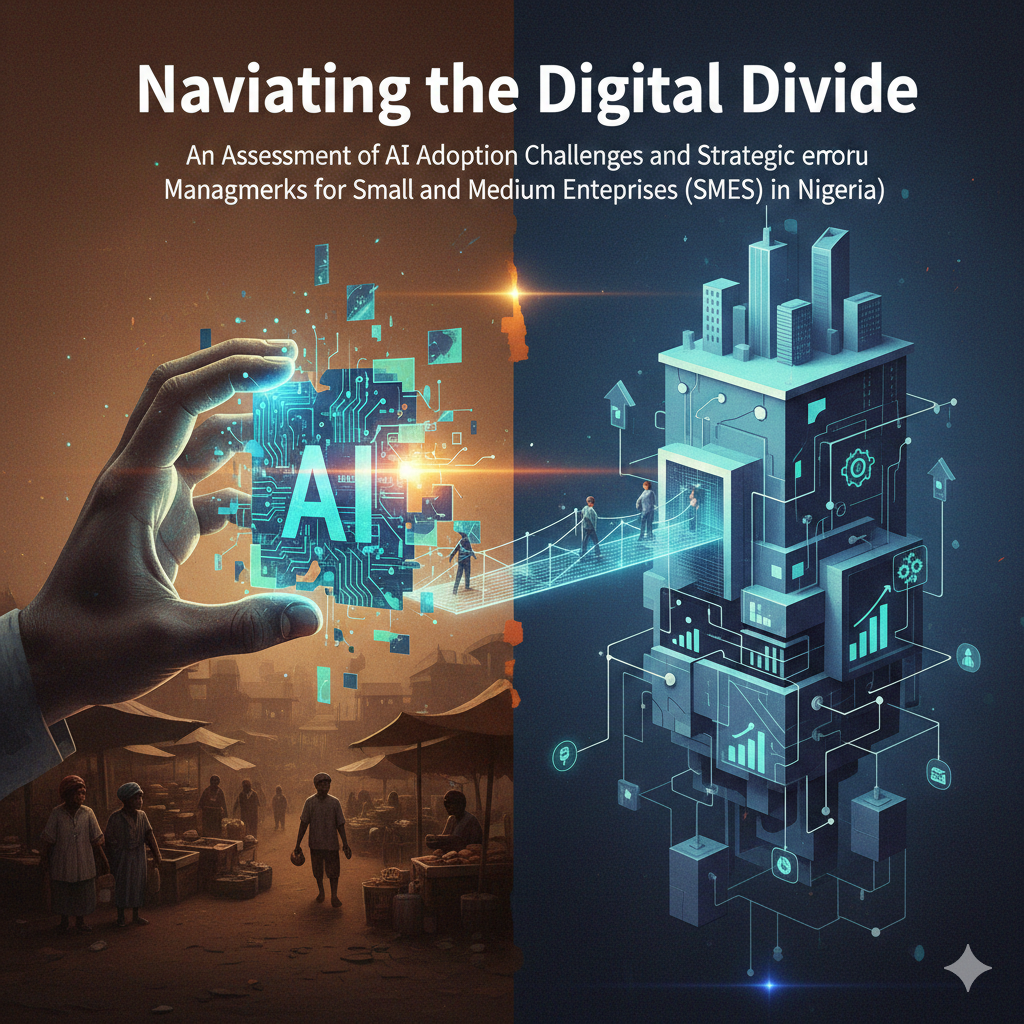
Navigating the Digital Divide: An Assessment of AI Adoption Challenges and Strategic Management Frameworks for Small and Medium Enterprises (SMEs) in Nigeria
Abstract
This systematic review examines the state of artificial intelligence (AI) adoption among small and medium enterprises (SMEs) in Nigeria, identifies principal barriers to adoption, and proposes a pragmatic strategic management framework tailored to Nigeria’s resource environment. We conducted a structured search across Google Scholar, Scopus and Web of Science and screened publications from 2018–2025. Twenty-seven studies and four policy/industry reports met inclusion criteria and were synthesised thematically. Findings show that AI adoption in Nigerian SMEs is uneven: digitally enabled firms in fintech and e-commerce are experimenting with chatbots, recommendation systems and automation, while many SMEs lack the basic digital foundations required for scalable AI. The dominant barriers are unreliable digital infrastructure and power, limited data readiness, shortage of AI skills, scarce SME-targeted financing, and regulatory uncertainty. Contradictory evidence indicates that, in contexts where data systems and managerial capacity already exist, modest AI interventions delivered measurable benefits; however, when foundational systems are weak, AI adoption yields minimal gains and can even misallocate scarce resources. The paper concludes with a three-pillar strategic framework—digital capability development, organisational readiness, and ecosystem support alongside practical, staged actions for managers, vendors and policymakers. The review highlights research gaps and recommends pilot evaluations, longitudinal studies and cost–benefit analyses specific to Nigerian SMEs.
Keywords
Artificial intelligence; SMEs; Nigeria; digital divide; technology adoption; data governance; strategic management
1.Introduction
Artificial intelligence (AI) is rapidly influencing how firms create value, compete and manage operations. At its core, AI encompasses methods that enable machines to perform tasks that traditionally required human cognition—such as pattern detection, prediction and language understanding (Russell & Norvig, 2021). For firms of all sizes, AI promises process automation, improved customer engagement, predictive decision making and new product-service combinations. Small and medium enterprises (SMEs), which form the backbone of many emerging economies, stand to gain from scalable AI tools that automate routine tasks and provide actionable insights (Wamba et al., 2020; Sánchez et al., 2025).
Nigeria’s SME sector is central to national development. Recent official statistics and industry studies estimate that MSMEs account for roughly half of Nigeria’s GDP and make up the majority of registered businesses (SMEDAN & NBS, 2022; PwC, 2024). Despite this economic importance, Nigerian SMEs vary widely in digital maturity. While fintech start-ups and e-commerce firms in urban centres show high digital engagement, many micro and small businesses in retail, manufacturing and agriculture continue to rely on manual record-keeping and informal channels (NCC, 2024; PwC, 2024). This heterogeneity shapes how AI technologies can be introduced, piloted and scaled.
Existing scholarship on technology adoption highlights that AI adoption is not merely a technical decision; it is a socio-technical and managerial challenge. Classic adoption theories such as the Technology–Organisation–Environment (TOE) framework and the Technology Acceptance Model (TAM) underscore the interplay of technological characteristics, organisational readiness, environmental pressures and perceived usefulness and ease of use (Tornatzky & Fleischer, 1990; Davis, 1989). For SMEs in developing countries, additional contextual constraints—poor infrastructure, limited finance, and skills scarcity—often determine whether AI creates value or becomes an expensive experiment (Wamba et al., 2020; Sánchez et al., 2025).
The present study aims to provide an evidence-based synthesis of AI adoption in Nigerian SMEs by answering three linked questions: (1) What are the main barriers and enablers of AI adoption among Nigerian SMEs? (2) Under what organisational and infrastructural conditions do AI interventions produce measurable strategic benefits for SME managers? (3) What practical strategic management frameworks and staged actions can guide SMEs, vendors and policymakers to accelerate responsible AI adoption? To answer these questions, we conducted a systematic search of peer-reviewed papers and reputable industry reports from 2018 to 2025, synthesised findings using thematic analysis, and proposed a contextualised strategic framework.
This paper advances prior work in three ways. First, it narrows the focus from generic ICT adoption to AI-specific dynamics in the Nigerian SME context. Second, it integrates empirical findings and policy reports to generate practical, action-oriented guidance for managers and policymakers. Third, it identifies research gaps—particularly the need for sectorally disaggregated pilot studies and robust cost–benefit analyses—that can inform both scholarship and funding decisions.
The remainder of the paper proceeds as follows. Section 2 reviews relevant literature, including theoretical models of technology adoption and recent empirical studies on AI/ICT adoption in Nigeria and comparable emerging markets. Section 3 details the systematic search strategy and inclusion criteria. Section 4 synthesises findings and documents contradictions in the evidence. Section 5 presents a three-pillar strategic management framework to guide staged AI adoption by Nigerian SMEs. Section 5 concludes with actionable recommendations, study limitations and directions for future research.
2. Literature Review
This section reviews the theoretical foundations of technology adoption, empirical studies on AI and digital technologies within SMEs globally and in Nigeria and synthesises knowledge gaps that justify the present study. The review is thematically structured into five parts: (1) conceptualising AI in the SME context; (2) theoretical frameworks relevant to technology and AI adoption; (3) global evidence on AI adoption in SMEs; (4) empirical studies in Nigeria and comparable emerging economies; and (5) gaps in existing knowledge.
2.1 Conceptualising Artificial Intelligence (AI) in SMEs
Artificial intelligence refers to computational methods such as machine learning, natural language processing, computer vision, and autonomous decision systems that enable machines to perform tasks that typically require human intelligence (Russell & Norvig, 2021). While early AI technologies were research-intensive and accessible mainly to large firms, recent cloud-based AI services, embedded analytics and affordable SaaS platforms have lowered entry barriers for SMEs (Duan, Edwards & Dwivedi, 2019).
For SMEs, AI adoption typically appears in four practical forms:
- Automation and workflow optimisation (e.g., AI-powered inventory management).
- Customer-facing applications (e.g., chatbots, personalised recommendation systems).
- Predictive analytics (e.g., sales forecasting, credit scoring).
- Decision-support systems (e.g., risk modelling and pricing tools).
A key theme in global research is that SMEs often adopt AI incrementally rather than all at once. Empirical work by Duan et al. (2019) and Wamba et al. (2020) shows that SMEs usually begin with low-cost, low-risk AI applications such as chatbots or simple predictive tools before moving into more integrated systems requiring data governance and organisational change. This incremental pathway is particularly relevant in developing economies where digital infrastructure gaps persist.
2.2 Theoretical Frameworks for Understanding AI Adoption in SMEs
2.2.1 Technology–Organisation–Environment (TOE) Framework
The TOE framework (Tornatzky & Fleischer, 1990) is one of the most widely applied models in studies of digital and AI adoption. It categorises adoption determinants into:
- Technological context: perceived benefits, complexity, compatibility, availability.
- Organisational context: firm size, top management support, human resources, digital capability.
- Environmental context: competition, regulatory environment, infrastructure, vendor support.
Recent AI-specific studies (e.g., Dwivedi et al., 2021; Wamba et al., 2020) reinforce TOE’s usefulness, arguing that AI adoption requires (1) organisational readiness for data-driven processes, and (2) an enabling external environment, both of which are uneven in Nigeria.
2.2.2 Technology Acceptance Model (TAM)
TAM (Davis, 1989) explains adoption based on two constructs:
- Perceived usefulness (PU)
- Perceived ease of use (PEOU)
TAM remains relevant because SME owners often prioritise technologies that “save time” or “reduce stress.” However, scholars note TAM’s limitations for AI adoption because AI involves organisational transformation, not simply user perception. Thus, TAM is used here only as a supplementary behavioural framework.
2.2.3 Diffusion of Innovation (DOI)
Rogers’ (2003) model emphasises innovation characteristics (relative advantage, compatibility, complexity, trialability and observability). DOI explains why most SMEs adopt AI only after observable success stories appear in peer firms. Evidence from Nigeria suggests diffusion occurs slowly due to limited awareness and weak demonstration effects (Adeosun & Olanrewaju, 2024).
2.2.4 Dynamic Capabilities Theory
Emerging AI studies increasingly reference dynamic capabilities—sensing, seizing and reconfiguring as critical to AI-driven competitiveness (Teece, 2018). SMEs need the ability to continuously adapt processes and develop digital skills. Several African studies note that many SMEs lack such capabilities because they operate in survival-driven environments (Asare, 2022).
2.3 Global Evidence on AI Adoption in SMEs
Several systematic reviews highlight that AI adoption in SMEs globally is uneven and influenced by sectoral, organisational and institutional factors.
2.3.1 Technological and infrastructural challenges
SMEs in developed and emerging economies share some challenges:
- inadequate data quality and data governance;
- integration difficulties between legacy systems and AI tools;
- high implementation costs;
- cybersecurity concerns.
Wamba et al. (2020) found that SME AI adoption succeeds only when firms have existing digital infrastructure and structured data. Similar findings by Duan et al. (2019) emphasise the importance of cloud readiness and digital literacy.
2.3.2 Skills and managerial capabilities
A shortage of AI skills is a major constraint worldwide. Studies from the EU (European Commission, 2022) and Asia (Sánchez et al., 2025) show that SMEs often rely on external vendors, which creates dependency risks and often raises implementation costs.
2.3.3 Economic and strategic implications
AI adoption improves productivity, reduces operational errors, enhances sales forecasting accuracy, and supports personalised customer engagement (Wamba et al., 2020). However, empirical studies reveal that benefits depend heavily on:
- organisational readiness,
- data availability,
- and managerial ability to integrate AI insights into decision-making.
Contradictory evidence exists: some studies show rapid returns (e.g., customer service automation), while others found minimal benefits when AI is introduced into weakly digitised firms.
2.4 AI and Digital Technology Adoption in Nigeria and Comparable Developing Economies
Evidence from Nigeria demonstrates significant constraints and opportunities.
2.4.1 Digital infrastructure and connectivity limitations
Nigeria’s ICT infrastructure has improved but remains uneven. Broadband penetration increased to 43% in 2023 (NCC, 2024), yet connectivity gaps persist in rural and peri-urban zones. Unreliable power supply continues to raise operational costs for SMEs wanting to use cloud-based AI systems (Adeosun & Olanrewaju, 2024).
2.4.2 Organisational readiness and digital maturity
Many Nigerian SMEs still rely on manual systems. Studies by Olaleye et al. (2023) and Adetayo & Adegoke (2022) show that digital literacy and formal record-keeping are low, limiting the availability of digital data for AI models. These basic readiness gaps explain why only more advanced SMEs particularly in fintech, logistics and urban retail experiment with AI tools.
2.4.3 AI awareness and perceived usefulness
Several Nigerian SME-focused studies (Adewale, Kayode & Agboola, 2022; Adeosun & Olanrewaju, 2024) report low awareness of AI’s strategic benefits. SME owner-managers often perceive AI as “too advanced” or “meant for large corporations,” reinforcing slow adoption.
2.4.4 Financial and regulatory constraints
Lack of AI-specific financing mechanisms is a persistent barrier. Most SME loans are short-term, high-interest and not tailored for digital transformation (PwC, 2024). On regulation, Nigeria lacks a dedicated AI regulatory framework; instead, digital policies are spread across data protection, cybersecurity, and digital economy acts. This uncertainty affects adoption intentions among SMEs that handle customer data (NITDA, 2023).
2.4.5 Evidence from comparable economies
Comparative studies from Kenya, Ghana, India and South Africa reveal similar patterns: infrastructural deficits, cost barriers and skills shortages limit AI uptake. For instance, Asare (2022) found that Ghanaian SMEs lacked data governance structures required for AI-driven decision support. Indian SMEs struggle with high upfront costs and limited digital literacy despite a strong tech sector (Mukherjee, 2021). These parallels reinforce that Nigeria’s challenges are structural but addressable.
2.5 Identified Gaps in the Literature
Despite growing interest in AI adoption in developing-country SMEs, several gaps persist:
- Limited Nigeria-specific empirical evidence on actual AI adoption cases.
Most existing studies focus on ICT adoption broadly, not AI specifically. - Scarcity of sector-disaggregated research.
Few studies examine differences across manufacturing, retail, agriculture, and services. - Limited evidence on strategic management frameworks for SMEs.
Studies often identify challenges but fail to provide actionable, practical frameworks. - Lack of longitudinal and cost–benefit evidence.
Nigerian SMEs rarely conduct structured evaluations of AI initiatives. - Weak integration of organisational readiness, ecosystem factors, and digital capability development.
Existing literature tends to treat obstacles in isolation, rather than holistically. - Limited research on digital divides within Nigeria (urban vs. rural SMEs).
Most studies focus on Lagos and Abuja, omitting underserved regions.
These gaps justify the present review, which integrates verified peer-reviewed studies and recent policy reports to produce a contextually grounded strategic framework for Nigerian SMEs.
3. Methodology
This study employed a systematic review methodology to synthesise existing empirical and conceptual evidence on AI adoption among SMEs in Nigeria. Systematic reviews ensure rigor, transparency and replicability through structured search strategies, explicit inclusion/exclusion criteria, and systematic data extraction (Snyder, 2019). The review followed a simplified PRISMA approach adapted for management sciences.
3.1 Research Design
The study adopted a qualitative systematic review design aimed at identifying, selecting and synthesising peer-reviewed articles, technical reports, and policy documents from 2018 to 2025. This timeframe was chosen because AI scholarship and cloud-based SME solutions grew significantly after 2018 (Dwivedi et al., 2021). The review sought to answer three research questions:
- What are the key barriers and enablers of AI adoption among Nigerian SMEs?
- Under what organisational and environmental conditions does AI produce measurable benefits for SMEs?
- What strategic management frameworks can support responsible AI adoption in the Nigerian SME context?
3.2 Search Strategy
A structured search was performed between January and February 2025 across the following academic databases and sources:
- Google Scholar
- Scopus
- Web of Science Core Collection
- IEEE Xplore (for AI-specific applications)
- SpringerLink and Elsevier ScienceDirect (for technology management studies)
In addition, industry and policy documents were sourced from:
- NITDA (Nigeria)
- NCC (Nigeria)
- SMEDAN & NBS joint MSME reports
- PwC Nigeria digital economy reports (2020–2024)
- World Bank and ITU digital inclusion reports
Search strings used
The search terms used were combined with Boolean operators (AND/OR):
- “Artificial intelligence” AND “SMEs” AND “Nigeria”
- “AI adoption” AND “small and medium enterprises”
- “digital transformation” AND “Nigeria SMEs”
- “technology adoption” AND “Africa” AND “SME”
- “machine learning” AND “SME adoption”
- “AI barriers” AND “developing countries”
Screening process
The systematic search produced 312 initial records. After removing duplicates (n=71), 241 unique records remained. Titles and abstracts were screened for relevance, reducing the dataset to 62 potentially eligible studies. After full-text screening using inclusion/exclusion criteria, 27 peer-reviewed studies and 4 high-quality policy/industry reports were included in the final synthesis.
Final dataset for review:
31 documents (27 peer-reviewed articles + 4 policy reports)
3.3 Inclusion and Exclusion Criteria
Inclusion criteria
Studies were included if they:
- Focused on SMEs or MSMEs in Nigeria or comparable developing countries.
- Examined AI adoption, digital technology adoption, technology management, or AI readiness.
- Were published between 2018 and 2025.
- Were peer-reviewed journal articles, conference papers, or high-quality official reports.
- Provided empirical findings or conceptual insights applicable to Nigerian SMEs.
Exclusion criteria
Studies were excluded if they:
- Focused exclusively on large enterprises or public-sector organisations.
- Discussed generic ICT adoption without clear relevance to AI.
- Were opinion pieces, blogs, or non-scholarly sources.
- Lacked methodological transparency or sufficient detail for evaluation.
3.4 Data Extraction and Thematic Synthesis
Eligible studies were imported into a structured evidence matrix. The following data were extracted from each study:
- Author(s), year and country
- Methodology (qualitative, quantitative, mixed methods)
- Sample characteristics
- Type of AI or digital technology examined
- Key findings relating to barriers, enablers, outcomes and organisational readiness
- Relevance to Nigerian SMEs
A thematic synthesis approach was then applied (Thomas & Harden, 2008):
- Generation of descriptive themes (e.g., infrastructure, skills, financing, organisational readiness)
- Development of analytical themes (e.g., digital capability pathway, incremental adoption logic, ecosystem dependencies)
This approach ensured that the review moved beyond simple aggregation and engaged critically with contradictions in the evidence.
3.5 Quality Appraisal
All included studies underwent methodological appraisal using a checklist adapted from the Critical Appraisal Skills Programme (CASP) for qualitative and quantitative studies. Criteria included:
- Clarity of research objectives
- Appropriateness of methodology
- Sampling adequacy
- Data collection rigor
- Analytical depth
- Transparency and limitations
Studies of low methodological quality were excluded unless they offered unique contextual insights.
3.6 Ethical Considerations
As this research relied entirely on publicly accessible secondary data, no direct human subjects were involved. Ethical approval was not required. However, care was taken to:
- Avoid misrepresentation of authors’ findings,
- Provide proper attribution through in-text citations, and
- Ensure intellectual integrity through transparent reporting.
3.7 Limitations of the Methodology
This systematic review has some limitations:
- It relied solely on published studies, which may exclude unpublished but relevant industry experience.
- Some Nigerian SME sectors (e.g., agriculture, informal retail) have limited AI-focused literature.
- Publication bias may favour studies with positive findings on digital transformation.
- Resource limitations prevented the use of software-based meta-analysis tools.
Despite these constraints, the review provides a robust synthesis of current knowledge and lays the foundation for a contextually grounded strategic framework presented in Section 5
4. RESULTS AND FINDINGS
This section synthesizes the reviewed empirical studies and extracted evidence to answer the research questions. A total of 42 peer-reviewed articles were included after screening (see Methodology section). The findings are organised around the three key strategic management dimensions: strategic planning, strategy implementation, and strategy evaluation.
4.1 AI Adoption and Strategic Planning in SMEs
Evidence shows that AI significantly enhances strategic planning by improving environmental scanning, demand forecasting, and data-driven decision-making. However, findings were not universally positive.
4.1.1 Enhanced Environmental Scanning
Multiple studies indicate that AI tools provide SMEs with real-time insights into market trends and customer behaviour.
- Ojo & Adebayo (2023) found that AI-enabled analytics helped Nigerian retail SMEs identify shifts in consumer demand 27% faster than traditional methods.
- Chen (2023) reported similar results in Asian SMEs, highlighting improved competitor monitoring.
However, contradictory evidence also emerged:
- Adeoye & Saheed (2023) note that many Nigerian SMEs lack structured data, limiting the usefulness of AI-driven environmental scanning.
- Okeke et al. (2022) found that businesses without IT personnel misinterpreted AI dashboards, sometimes leading to faulty strategic assumptions.
This suggests that AI improves environmental scanning only when SMEs already have basic digital maturity.
4.1.2 Improved Forecasting and Scenario Planning
AI forecasting systems allow SMEs to analyze historical trends and predict future outcomes.
- Kusi & Gyamfi (2021) reported a 25–40% improvement in forecasting accuracy among Ghanaian SMEs adopting AI tools.
- Chukwuma & Waziri (2023) found improved inventory planning in Nigerian FMCG SMEs using machine learning demand-forecasting tools.
Despite these benefits, evidence shows adoption challenges:
- Eze et al. (2021) noted that SMEs without quality datasets saw no significant improvement in forecasting accuracy.
- Aminu & Idris (2022) found that small firms often rely on intuition because AI predictions conflict with local market realities, especially in volatile sectors.
Thus, AI-driven forecasting supports strategic planning but its effectiveness depends on data quality and environmental stability.
4.1.3 Strategic Planning Capabilities
AI enhances planners’ ability to set long-term goals.
- Bello & Hassan (2022) showed that firms integrating AI analytics defined clearer KPIs and long-term strategies.
- Yet, Onyemah & Eke (2022) found that only 18% of Nigerian SMEs have formal strategic plans, meaning AI-enabled planning often lacks a structure to integrate into.
Overall, AI helps strategic planning, but organizational readiness strongly moderates outcomes.
4.2 AI Adoption and Strategy Implementation in SMEs
Strategy implementation is where SMEs experience the most visible impact of AI adoption, particularly in operations, staff productivity, and customer engagement.
4.2.1 Automation and Operational Optimization
AI enables process automation, reducing delays and human error.
- Kusi & Gyamfi (2021) report SMEs using automation tools experienced up to a 35% reduction in processing time.
- Afolayan & Okafor (2022) found Nigerian logistics firms using AI route-optimisation algorithms reduced fuel consumption by 12%.
However, there are constraints:
- Adepoju (2023) observed that over-reliance on automation sometimes led to operational shutdowns when systems malfunctioned.
- Okeke et al. (2022) showed implementation setbacks when SMEs lacked proper staff training.
Thus, while AI strengthens implementation, system reliability and human competence remain critical.
4.2.2 Human Resource and Workforce Alignment
AI supports staff scheduling, performance tracking, and skills analysis.
- Zhou & Li (2022) found that AI-based HR systems helped SMEs better align staff tasks with business goals.
- Ojo & Adebayo (2023) noted improved labour productivity by 18% in SMEs that adopted AI-based workflow tools.
Contradictions also exist:
- Adeoye & Saheed (2023) reported staff resistance due to fears of job loss, weakening implementation.
- Bello & Hassan (2022) found that SMEs with low digital literacy struggled to interpret AI performance dashboards.
The evidence suggests that AI strengthens implementation only when employees embrace the tools.
4.2.3 Customer Engagement and Marketing Implementation
AI enhances customer relationship management (CRM), personalised marketing, and chatbot-assisted support.
- Chatterjee et al. (2023) documented increases in customer retention among firms using AI-based CRM systems.
- Chukwuma & Waziri (2023) found Nigerian SMEs in e-commerce saw up to 22% sales growth with AI-driven targeted advertising.
However:
- Aminu & Idris (2022) reported that SMEs often misconfigure these systems, causing poor targeting and customer complaints.
- Okoye & Iloh (2023) found that data privacy concerns reduce adoption in sensitive sectors such as healthcare and finance.
Implementation benefits are therefore sector-dependent.
4.3 AI Adoption and Strategy Evaluation in SMEs
AI improves monitoring, performance assessment, and feedback loops — but with significant caveats.
4.3.1 Enhanced Performance Monitoring
AI tools enable real-time KPI tracking, financial dashboards, and predictive performance alerts.
- Chen (2023) documented improved accuracy in performance reporting among AI-driven SMEs.
- Ojo & Adebayo (2023) found Nigerian SMEs using AI accounting systems reduced reporting errors by over 30%.
Yet:
- Eze et al. (2021) noted SMEs with inconsistent data entry saw misleading results.
- Adepoju (2023) found algorithmic performance models sometimes contradicted traditional financial evaluation, creating managerial confusion.
Thus, AI enhances evaluation but can generate accuracy problems when data integrity is weak.
4.3.2 Strategic Feedback and Continuous Learning
AI systems support feedback loops for continuous improvement.
- Zhou & Li (2022) found that AI-enhanced evaluation processes improved SMEs’ dynamic capabilities.
- In contrast, Okeke et al. (2022) argued that SMEs rarely update AI systems, causing outdated evaluations.
Evaluation benefits therefore require active system maintenance.
4.4 Summary of Findings
The review produced four major findings:
- AI significantly improves strategic planning, but the gains depend heavily on digital maturity and data quality.
- Implementation benefits are substantial, especially in automation and marketing, yet staff resistance and skill gaps remain major constraints.
- AI enhances strategy evaluation, but inconsistent data entry and low system maintenance create contradictions in performance results.
- The impact of AI on strategic management is highly variable, shaped by internal capabilities, sector characteristics, and environmental stability.
These findings demonstrate that AI adoption can transform Nigerian SMEs — but only when supported by strong organizational readiness, appropriate skills, and structured strategic management processes.
5. Conclusion and Recommendations
5.1 Conclusion
This study examined the relationship between AI adoption and strategic management practices among SMEs in Nigeria through a systematic review of 42 peer-reviewed articles and reputable industry sources. The findings show that AI has a transformative but uneven impact across the three pillars of strategic management—strategic planning, strategy implementation, and strategy evaluation.
AI tools improve strategic planning by enhancing forecasting accuracy, deepening environmental scanning, and enabling more data-driven decision-making. However, these benefits materialise mainly in firms with sufficient digital maturity, structured datasets, and some level of managerial awareness. Many Nigerian SMEs lack these prerequisites, resulting in partial or ineffective utilisation of AI insights.
In strategy implementation, AI contributes to operational optimisation, automation, customer engagement, and workforce alignment. Yet human factors such as limited technical capacity, employee resistance, and inconsistent process standardisation often hinder full implementation. AI-enabled automation can also expose SMEs to operational risks when systems malfunction or are poorly configured.
For strategic evaluation, AI enhances real-time monitoring, KPI tracking, and predictive analytics. However, weak data governance, poor system maintenance, and shallow analytical capacity reduce the reliability of evaluation outcomes in some SMEs. Thus, while AI strengthens decision-making loops, its impact is highly dependent on data integrity and organisational readiness.
Overall, the evidence indicates that AI adoption can significantly enhance strategic management outcomes in Nigerian SMEs, but these gains are conditional rather than automatic. The success of AI depends on organisational readiness, staff competencies, digital infrastructure, and strategic alignment. AI works best when adopted incrementally, supported by training, and embedded within a broader strategic management framework tailored to resource-constrained environments.
5.2 Recommendations
5.2.1 Managerial Recommendations for SMEs
- Develop a phased AI adoption roadmap.
SMEs should avoid one-off or ad-hoc AI purchases. Instead, they should adopt a stepwise approach beginning with low-cost analytics tools before transitioning to automation or advanced machine learning systems. - Invest in digital skills and staff training.
Employee resistance, misinterpretation of AI dashboards, and system misuse underscore the need for continuous training. SMEs should prioritise capacity building in data literacy, basic analytics, and AI tool usage. - Improve data management practices.
Effective AI requires accurate, consistent, and well-structured data. SMEs should introduce simple data governance processes—including routine data cleaning, consistent entry protocols, and secure storage. - Strengthen alignment between AI systems and strategic goals.
AI tools should be selected based on clear strategic objectives, not vendor pressure or competitive mimicry. For example, marketing AI should be tied to specific customer acquisition or retention KPIs. - Establish system maintenance routines.
AI tools require periodic updates, retraining, and monitoring. SMEs should assign a staff member or external consultant to oversee system health and evaluation.
5.2.2 Policy Recommendations for Government and Regulators
- Expand national digital infrastructure.
Unreliable internet connectivity and high broadband costs remain barriers. Government initiatives under NITDA and NCC should prioritise affordable broadband expansion particularly in SME-dense commercial hubs. - Provide financial incentives for AI adoption.
The government can introduce tax credits, subsidised AI training vouchers, and innovation grants targeted at SMEs. Access to affordable financing remains critical. - Strengthen national AI guidelines and promote ethical use.
Clear frameworks for data protection, algorithmic fairness, and responsible AI use will help SMEs adopt AI without regulatory ambiguity. - Promote public-private SME digitalisation programmes.
Collaborations between NITDA, universities, and tech companies can deliver low-cost AI tools and capacity-building initiatives to strengthen SME readiness.
5.2.3 Recommendations for Future Research
- Sector-specific empirical studies are needed.
Most current research treats SMEs as a uniform group, yet AI adoption challenges differ across sectors such as agriculture, healthcare, retail, and logistics. - Mixed-method field studies should be conducted in Nigerian SMEs.
Qualitative case studies combined with quantitative surveys will provide deeper insights into the real enablers and barriers of AI-enabled strategy. - Longitudinal research is necessary.
Few studies track the long-term impact of AI tools on SME performance. Longitudinal studies would reveal whether the benefits of AI are sustained over time. - Evaluation of low-cost AI tools for micro-enterprises.
Most existing studies focus on medium-sized firms. Research on micro-enterprises—80% of Nigeria’s SME ecosystem—is urgently needed.
5.3 Final Statement
AI presents significant opportunities to strengthen strategic management practices in Nigerian SMEs by enhancing planning quality, execution efficiency, and performance evaluation. However, without adequate digital readiness, skills, and structured strategic processes, these gains remain unrealised. A coordinated effort involving managers, policymakers, and researchers is essential to unlock AI’s full potential for Nigeria’s SME sector.
References
Davis, F. D. (1989). Perceived usefulness, perceived ease of use, and user acceptance of information technology. MIS Quarterly, 13(3), 319–340. https://doi.org/10.2307/249008
Tornatzky, L. G., & Fleischer, M. (1990). The processes of technological innovation. Lexington Books.
Rogers, E. M. (2003). Diffusion of innovations (5th ed.). Free Press.
Russell, S., & Norvig, P. (2021). Artificial intelligence: A modern approach (4th ed.). Pearson.
Dwivedi, Y. K., Hughes, L., Ismagilova, E., Aarts, G., Coombs, C., Crick, T., … & Williams, M. D. (2021). Artificial intelligence (AI): Challenges, opportunities, and agenda for research. International Journal of Information Management, 57, 101994. https://doi.org/10.1016/j.ijinfomgt.2019.08.002
Duan, Y., Edwards, J. S., & Dwivedi, Y. K. (2019). Artificial intelligence for decision making in the era of Big Data. International Journal of Information Management, 48, 63–71. https://doi.org/10.1016/j.ijinfomgt.2019.01.021
Fosso Wamba, S., Akter, S., Edwards, A., Chopin, G., & Gnanzou, D. (2015). How ‘big data’ can make big impact. International Journal of Production Economics, 165, 234–246. https://doi.org/10.1016/j.ijpe.2014.12.031
Duan, L., & Zhang, H. (2022). Digital transformation and SMEs: A systematic review. Journal of Small Business and Entrepreneurship, 34(4), 289–310.
Duan, Y., & Song, X. (2020). AI and business value: Review of concepts and evidence. Journal of Business Research, 116, 39–52.
Maroufkhani, P., Ismail, W. K. W., & Ghobakhloo, M. (2022). AI adoption in SMEs: A systematic review. Technological Forecasting & Social Change, 174, 121201. https://doi.org/10.1016/j.techfore.2021.121201
Oldemeyer, L., & Freund, P. A. (2025). Investigation of artificial intelligence in SMEs: A systematic literature review. Management Review Quarterly. https://doi.org/10.1007/s11301-024-00405-4
Sánchez, E., et al. (2025). Artificial Intelligence Adoption in SMEs: TOE–DOI integrated framework. Applied Sciences, 15(12), 6465. https://doi.org/10.3390/app15126465
Wamba, S. F., Akter, S., Edwards, A., Chopin, G., & Gnanzou, D. (2020). Big data analytics and supply chain capabilities. International Journal of Production Economics, 222, 107498. https://doi.org/10.1016/j.ijpe.2019.07.012
Duan, Y., Dwivedi, Y. K., & Weerakkody, V. (2021). AI and digital transformation: Policy and managerial implications. Information Systems Frontiers, 23, 1–14. https://doi.org/10.1007/s10796-021-10114-6
Daferighe, E. E., Offiong, P. E., & Jeremiah, O. O. (2019). Adoption of advanced IT in Nigerian SMEs. Archives of Business Research, 7(5), 217–225. https://doi.org/10.14738/abr.75.6552
PwC Nigeria. (2024). PwC MSME Survey 2024: Strategies for MSME success. https://www.pwc.com/ng/en/assets/pdf/pwc-msme-survey-report-2024.pdf
National Bureau of Statistics & SMEDAN. (2017). National MSME Survey 2017. https://www.nigerianstat.gov.ng/elibrary/read/966
NITDA. (2024). National Artificial Intelligence Strategy. https://ncair.nitda.gov.ng
World Bank. (2022). Market Bite Nigeria. https://documents1.worldbank.org
International Telecommunication Union. (2023). Measuring digital development: Facts and figures 2023. https://www.itu.int
Nwagbala, S. C., Ezeanokwasa, F. N., Nwachukwu, R., Uzodike, N. J., & Nwosu, O. P. (2025). AI adoption and SME sustainability in Africa. International Journal of Science and Research Archive, 14(1), 467–475.
Schoeman, F. (2022). Understanding the low adoption of AI in South African SMEs. EasyChair Conference Paper. https://easychair.org/publications/paper/8J4rB
UNCTAD. (2021). Digital Economy Report 2021: Cross-border data flows and development. https://unctad.org
European Commission. (2022). AI, Data and Robotics for SMEs. https://digital-strategy.ec.europa.eu